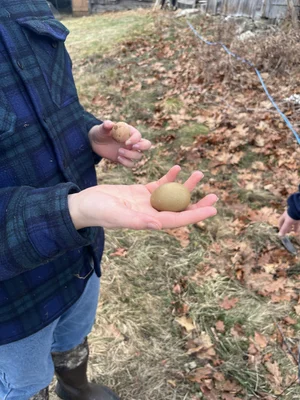
Eurovision Egg Contest: The Story of Chicken Saga
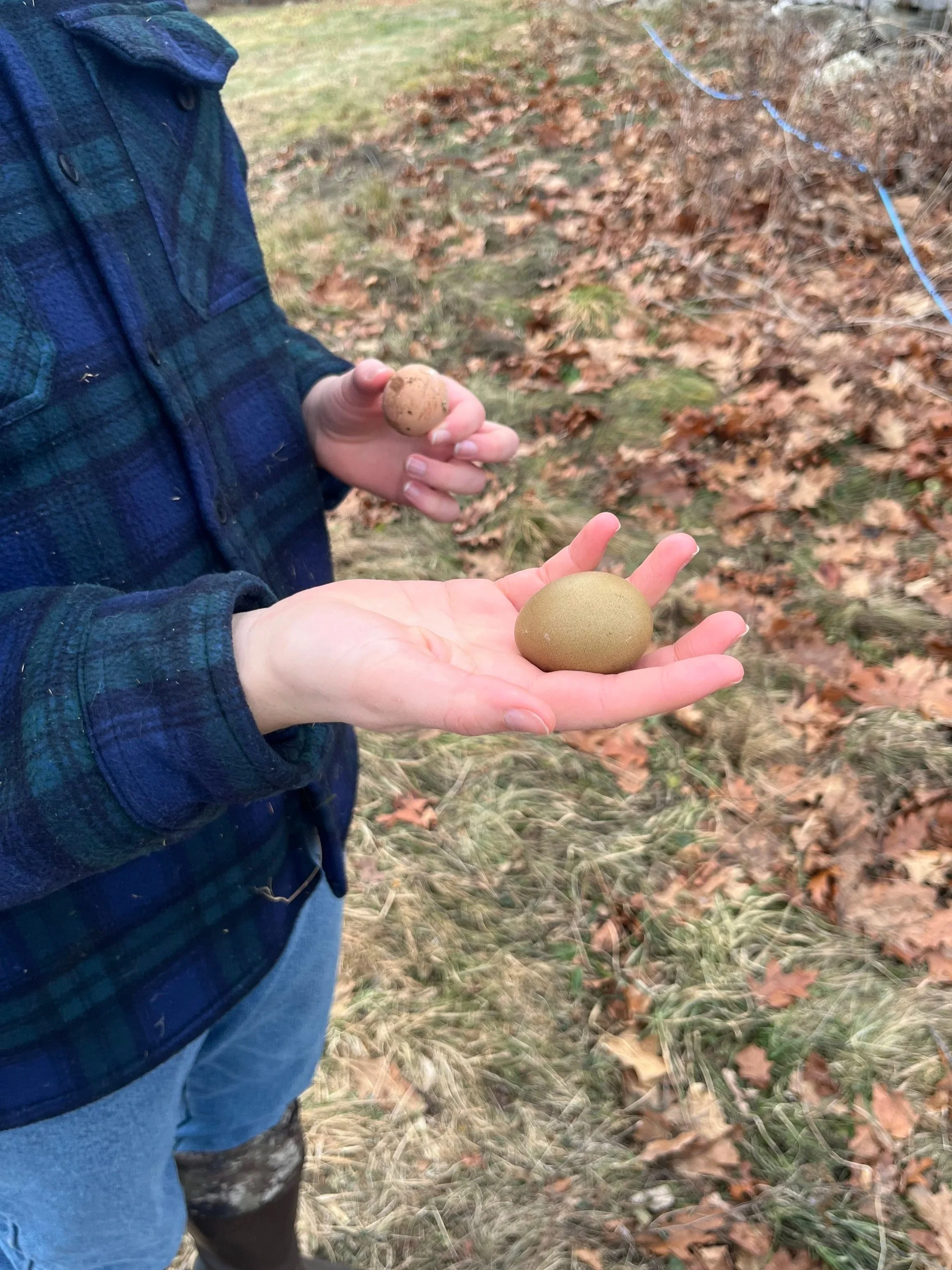
The very first eggs laid at Wilde Fell Farm, December 21, 2025.
On an unseasonably warm January morning, we officially became farmers when we sold our first dozen eggs to our friends. With $4k spent on our chicken operation so far, if we continued getting five whole dollars a day, we’d be making a profit in… no time? As we danced about our kitchen excitedly waving those precious five singles in the air, we had to pause to ask, how did we get here?
It all started back on July 31, with a startlingly small cardboard box packed with fluffy chirping 1-day-old chicks. We’d decided to order 26 birds in a variety breeds, including some sexed and some unsexed chicks. The box arrived with 31 sentient pom-poms in gray, yellow, chipmunk, and black. It would be weeks before we could truly begin to discern the sex and breed of each. We piled them into a much bigger cardboard box (retained from the purchase of a lawnmower early that summer) lined with soft paper bedding and outfitted with a waterer, food dispenser, a cozy brooder plate, and a few shiny toys for them to peck and explore.
Soon after the chicks nestled into their first home, we had to get cracking on building their second home. It wouldn’t be long before they outgrew their lawnmower box, even after we expanded the cardboard condo with a refrigerator box annex.
The chicks’ second home was a 2x4 A-frame luxury cabin with four roosts and three nesting boxes. A ramp descended from its internal platform onto the ground, where the open base allowed them to scratch at the grass and learn to catch crickets.
By mid September, the chicks, now classifiable as pullets and cockerels, were large enough to roam freely during the day and happily pack themselves back into their A-frame at night. We were finally able to count seven cockerels in the flock, and some of the hens began to stand out and earn names. “Meatball” the perfectly spherical Ameraucana; “Bellybutton” because she still had hers attached as a chick; “Joan” as in Jett, named for her punk-rock hairdo; and “Chicken” who looks exactly like a chicken should. The first problem occurred when we decided to cut out a large patch of invasive barberry, and upon learning of its well-earned reputation as a tick habitat, decided to move the A-frame onto the patch of land previously occupied by the barberry thicket (tick-et?). We had intended to make the A-frame mobile with the addition of wheels, but our engineering ingenuity only took us so far. In the end, it took two people, a hand-truck, and roughly 30 minutes of sweating and cursing to move the dratted thing a mere 50 feet. The chickens did enjoy all the tasty arachnid snacks in their new front yard, though.
But the A-frame was only designed to be used in warmer months, and would only fit ten adult chickens. In their early adolescence, all 31 fit easily in the little cottage with room to spare, but they were growing just as fast as winter was approaching. By the end of October, they were due for another upgrade. This time we had the benefit of existing infrastructure. All we needed to do was put up some new shingles and a new door on a perfectly sized storage shed attached to our ancient barn. We added some roosts and voila, a winter coop! (I made this sound way easier than it actually was. Stay tuned for a barn-rehab post!)
You may have heard a certain idiom about chickens always coming home to roost? It’s a saying rooted in a deep truth about chicken behavior that is wonderfully convenient… until you want to change where your chickens call home. We solved this problem by waiting until the dark of night and kidnapping our chickens one by one. The first few came easy. It’s not difficult to snatch a sleeping bird from its perch and quickly tuck it under your arm. But while chickens might be bird-brained, they’re smart enough to notice when their friends start vanishing into the night. As the remaining birds dwindled in number, they got harder and harder to catch. The final hen earned her name “Fish” by refusing to be captured until we fished her out with a pole.
We got our first eggs on the winter solstice, one brown egg whose mother remains a mystery, and one green egg laid by Joan, our olive egger. Our hens have all since come to maturity and we can hardly wait to get our farm stand set up so we can share our bounty with all of you! It will still be months before we can harvest our first veggie crops, but Wilde Fell is off to a fantastic start, from just one tiny chirping cardboard box.